The majority of organizations maintain adequate skills to handle their operational challenges. The system experiences a malfunction, which initiates an investigation, resulting in a solution implementation, after which normal operations start again, but the same issue emerges again next month with different symptoms.
The distinction between problem-solving and process excellence remains fundamental to their respective functions. Problem-solving exists as a method which responds to unexpected events. Process excellence asks why something went wrong, whether it could happen elsewhere and what structural change prevents recurrence.
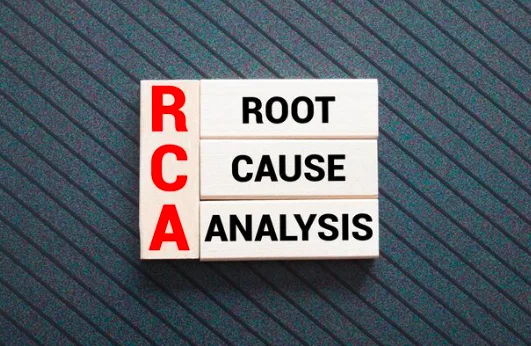
Root Cause Analysis (RCA) and an Integrated Management System (IMS) bridge that gap. The two systems function as separate entities which provide individual benefits. The two systems create a continuous improvement engine which enables organizations to transition from emergency handling to ongoing efficient operations.
What Root Cause Analysis Actually Means
Surface-level fixes are comfortable. They resolve the immediate disruption, satisfy the pressure to act quickly and allow work to continue. They also guarantee that the same problem or a close relative of it will return.
Root cause analysis is the discipline of going further. Rather than treating the symptom, RCA investigates the underlying conditions that allowed the problem to occur. It asks not just what happened, but why it happened and why those conditions existed in the first place.
The most widely used RCA methods each approach this from a slightly different angle. The 5 Whys technique traces causation by repeatedly asking why at each level of explanation until the root cause emerges. Fishbone diagrams also known as Ishikawa or cause-and-effect diagrams map potential causes across categories such as people, processes, equipment, environment and materials. Fault Tree Analysis uses a top-down logical structure to identify combinations of failures that lead to an undesired outcome.
The methods demonstrate discipline as their shared characteristic. Teams must allocate time to conduct methodical exploration of their problems instead of choosing immediate solutions which show clear results.
The process of discipline establishes boundaries that distinguish between organizations that succeed in their development and those which spend their time handling recurring problems.
The Risk of RCA Without a Management System
RCA can be conducted as a standalone activity, a response to a significant incident, a customer complaint, or a quality failure. Many organisations do exactly this. The individual RCA investigations produce valuable results but their existence as separate entities creates a fundamental constraint.
The findings exist in a report. The report designates specific corrective actions. The report states that some actions will be implemented while others will stop progressing after their initial urgent period ends. The system lacks any way to monitor completion status or assess results or distribute knowledge throughout the organization.
This is where integration matters. The organization needs a system to store its RCA findings which should drive responses and create operational improvements. The organization uses RCA as a reaction to incidents when it needs to implement continuous improvement processes because it lacks proper systems for doing so.
What an Integrated Management System Brings to the Table
An integrated management system consolidates multiple management frameworks quality, environment, health and safety and others into a single, coherent operational structure. Rather than maintaining separate systems for ISO 9001, ISO 14001 and ISO 45001, an IMS aligns the common elements: documentation, risk management, internal auditing, corrective actions and management review.
The benefit is not just efficiency. The deeper value is that an IMS makes learning systematic rather than accidental.
The IMS system uses RCA findings to assign CAPA tasks which establish specific responsibilities and completion dates. The organization uses tracking to monitor progress. The verification process determines whether the root cause was actually fixed instead of simply reviewing the completed actions. The organization makes its knowledge available for all employees to access instead of keeping it hidden in a departmental document.
Organizational intelligence emerges from the results of individual investigations.
Read also: Andre J. Lyson: the quiet architect who loved Kim Cattrall and built a life in Germany
How RCA and IMS Work Together in Practice
The relationship between RCA and an IMS is most visible in the corrective action process, but extends further.
Nonconformance and incident management Within an IMS, nonconformances and safety incidents are logged systematically. Those that meet a defined threshold trigger a formal RCA. The investigation is structured, documented and linked to the original record.
CAPA tracking and verification RCA outputs feed directly into the CAPA process. Actions are assigned, deadlines are set and completion is verified. Crucially, verification checks whether the root cause has actually been addressed not just whether the action was completed on paper.
Risk management Root causes often reveal systemic vulnerabilities beyond the specific incident. When fed back into the risk register, they sharpen risk identification and inform proactive controls.
Internal audit and management review RCA findings and CAPA trends are reviewed during internal audits and management reviews. Recurring root causes across different incidents signal process weaknesses that require structural attention rather than repeated individual fixes.
Cross-functional learning An IMS shares RCA findings across departments, sites and functions. A root cause identified in one area can inform process improvements elsewhere before a similar incident occurs.
The Continuous Improvement Connection
The Plan-Do-Check-Act (PDCA) cycle serves as the foundation for both RCA and IMS. The Check phase of RCA investigates the reasons behind the observed faults. The Act phase contains all required solutions to existing problems. The IMS system requires organizations to develop new procedures while conducting risk evaluations and establishing operational frameworks throughout their entire process.
Organizations that incorporate RCA into their management systems achieve superior outcomes in continuous improvement compared to organizations which use RCA as a temporary assessment method. The process of structured learning develops into a powerful educational method which builds knowledge over multiple learning sessions.
The organization achieves more than just problem solving when the cycle operates effectively. The organization enhances its essential systems which create the problems.
Moving From Reactive to Proactive
The organization achieves more than just problem solving when the cycle operates effectively. The organization enhances its essential systems which create the problems.
The main purpose of combining RCA with an IMS system is to improve incident investigation capabilities. The goal is to reduce the number of incidents which occur because the organization has achieved better prevention measures.
The shift from reactive to proactive function represents the complete embodiment of process excellence. The process requires organizations to implement two specific disciplines which include root cause analysis and integrated management system requirements. The analysis identifies root causes but lacks operational value without an established system to implement its findings. An organization which lacks RCA elements achieves compliance requirements but fails to establish authentic learning opportunities.
The two elements together establish greater value for the organization because their combination produces systematic performance improvements which enhance every operational aspect of the organization.
Final Thoughts
The organization depends on problem solving to maintain operations while process excellence enables continuous performance improvements. The organization achieves new operational heights through process excellence initiatives which establish fresh performance standards.
For quality leads, EHS managers and operations professionals serious about improvement, RCA combined with an integrated management system is not a theoretical framework, it is a practical operating model that converts every problem into a structured opportunity to improve.
The organisations that master this combination do not just recover from problems. They become harder to break.