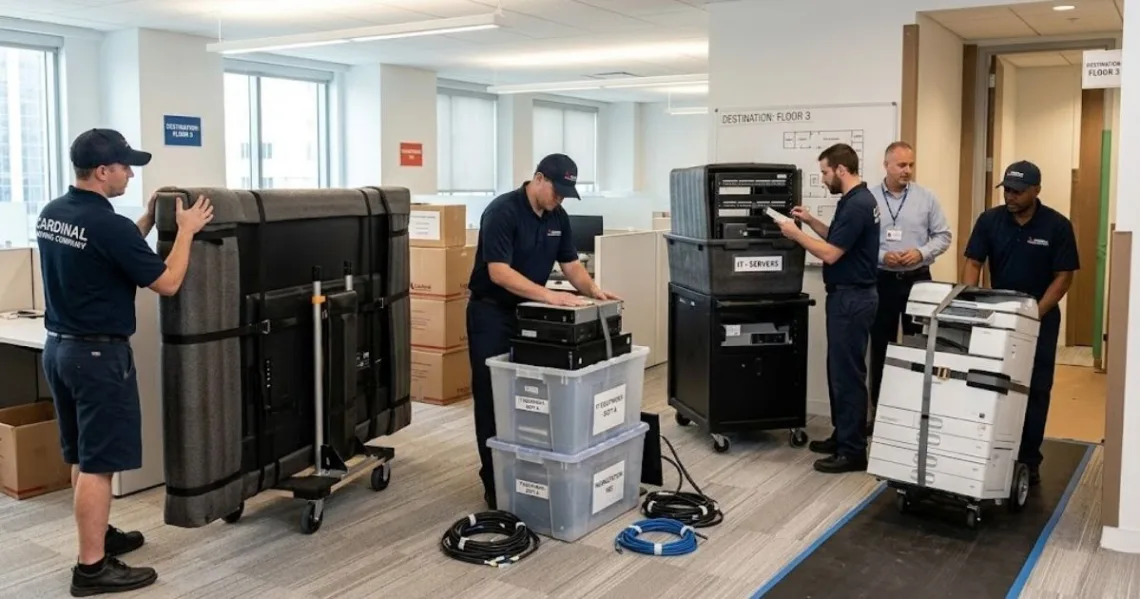
Office moves most often fail in the details that people underestimate. A desk can be replaced, but a damaged server, misplaced access-control panel, or cracked conference display can interrupt operations before the new space is even ready. For property managers, facility managers, and building owners, safe office equipment handling is not just about lifting furniture.
It is about protecting assets, reducing downtime, coordinating vendors, and ensuring the workplace can reopen without confusion. Commercial movers use planning, packing discipline, labeled workflows, and controlled transport methods to move equipment without turning relocation into a costly disruption.
Equipment Safety Starts Before Moving Day
- A Careful Inventory Sets Control
Safe handling begins with a documented inventory. Commercial movers identify what needs to be moved, where it sits now, and where it needs to go. Depending on the needs, office equipment may include computers, monitors, printers, copiers, servers, phone systems, conference technology, modular workstations, filing units, and reception equipment.
Without inventory control, items get misplaced, accessories go missing, and teams waste time searching for missing components. A proper inventory gives the move structure. It also helps managers decide which equipment should be moved, stored, recycled, or replaced before crews arrive.
- Planning Reduces Avoidable Damage
The strongest commercial moves are mapped before anyone lifts a box. Movers inspect access points, elevators, loading docks, stairwells, hallways, floor surfaces, doorway widths, and parking conditions. They also consider building rules, insurance requirements, freight elevator reservations, and after-hours restrictions.
A company listed under commercial movers near me can be part of a broader relocation plan when the focus is not only on transport but also on protecting office equipment through organized handling.
This early coordination reduces last-minute decisions, which are often the source of damage, delays, and avoidable labor costs.
- Packing Methods Depend On Equipment Type
Commercial movers do not treat every office asset the same way. Monitors need screen protection. Computers need stable packing that limits vibration. Printers and copiers may need internal parts secured before transport. Conference room displays require padding, edge protection, and careful positioning. Filing cabinets need contents managed according to weight, confidentiality, and stability.
Small electronics should be packed with cables, adapters, remotes, and docking stations, clearly grouped. This equipment-specific approach prevents a common moving mistake: using generic boxes and hoping delicate items survive. Proper packing turns loose assets into controlled loads.
- Cable Management Prevents Reconnection Delays
Cables are small, but they can create major downtime after a move. Commercial movers often label, bundle, and separate cords by workstation, conference room, or equipment group. This keeps power cords, HDMI cables, network cables, phone cords, chargers, docking lines, and peripheral connections from becoming a tangled pile at the destination.
For IT teams, labeled cable handling can save hours during reconnecting. For building owners and managers, it also reduces frustration during the first day back in operation. A safe move protects not only hardware, but also the setup needed to make that hardware useful.
- IT Equipment Requires Controlled Handling
Computers, servers, switches, routers, and storage devices demand more careful handling than ordinary office contents. Many businesses choose to have IT staff disconnect and prepare sensitive equipment before movers transport it.
Commercial movers then use padded carts, anti-static packing where needed, secure containers, and stable loading methods to reduce impact and vibration. Servers and network equipment should be moved in a way that avoids tipping, stacking pressure, and exposure to moisture or heat. The goal is clear: equipment should arrive ready for reconnection, not with hidden damage that appears after startup.
- Heavy Equipment Needs Proper Moving Tools
Office equipment can be awkward, dense, and difficult to maneuver. Copiers, large printers, safes, conference tables, filing systems, and modular furniture components require dollies, panel carts, straps, lift gates, ramps, and protective padding.
Trained movers use equipment designed for commercial loads instead of relying on manual force alone. This protects both the item and the building. Dragging heavy equipment can damage floors, walls, thresholds, and elevator interiors. Controlled movement also reduces the risk of worker injury. Safe handling depends on using the right tools for the weight, shape, and path of travel.
- Building Protection Is Part Of The Job
A commercial move affects more than the items being transported. Movers must protect the property itself. Door jambs, elevator walls, lobby floors, corridor corners, glass panels, and finished surfaces can all be damaged during a rushed relocation.
Commercial movers use floor runners, Masonite, corner guards, padding, and elevator protection when needed. For facility managers, this matters because building damage can create repair costs, tenant disputes, or security deposit issues. A move that protects equipment but leaves walls scraped and floors marked is still poorly controlled. Safe handling includes the space around the equipment.
Safe Handling Protects Business Continuity
Commercial movers safely handle office equipment by combining planning, packing, labeling, building protection, proper tools, secure loading, and clear destination control. The process is less about speed and more about reducing risk at each handoff.
For property managers, facility managers, and building owners, that discipline protects expensive equipment, prevents avoidable downtime, and helps employees return to work with fewer interruptions. A smooth office move does not happen by luck. It comes from treating every workstation, device, file system, and shared asset as part of the business operation, all of which must arrive intact and ready for use.
Read also: The Impact of Attic Insulation on Smart Home Energy Management Systems