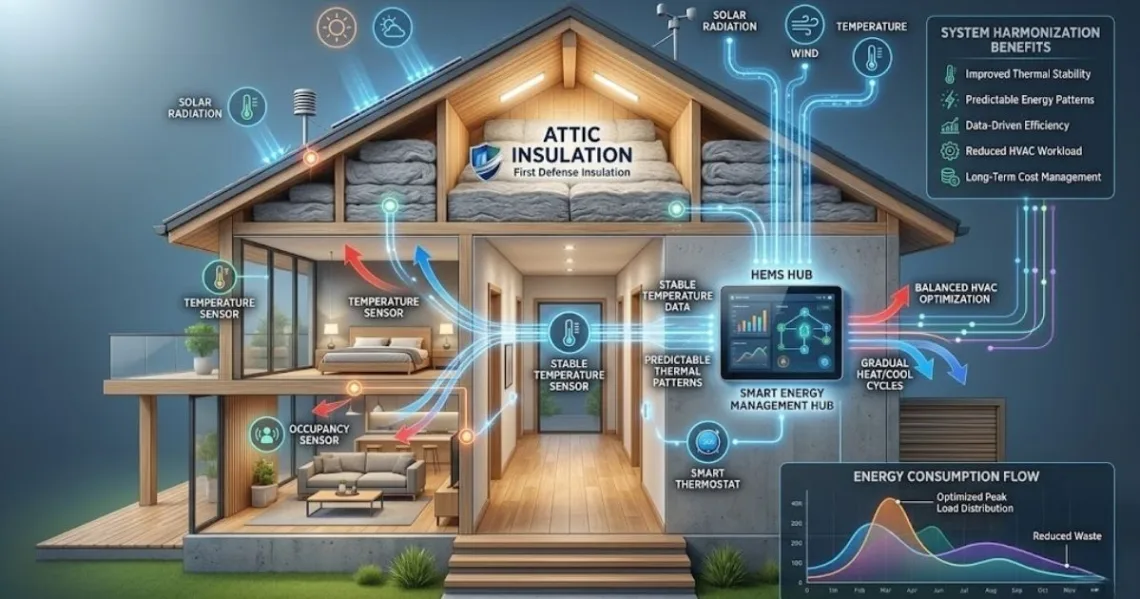
Attic insulation plays a significant role in shaping how modern smart home energy management systems operate. As homes become increasingly connected, thermal control is no longer just about comfort but also about data-driven efficiency. Insulation in the attic influences temperature stability, reduces HVAC workload, and provides more predictable energy patterns for smart systems to analyze. This interaction allows automated platforms to make more accurate adjustments to heating and cooling cycles.
Over time, the combination of insulation and intelligent monitoring supports an improved energy balance, reduced waste, and smoother integration of physical building performance with digital energy controls.
Smart Energy Foundations in Modern Homes
Thermal Stability and System Responsiveness
Attic insulation directly affects how stable indoor temperatures remain throughout changing external conditions, which in turn shapes how smart energy systems respond. When insulation limits heat transfer through the roof space, indoor environments experience fewer sudden fluctuations.
This stability allows smart thermostats and energy management systems to operate with more predictable data inputs. Instead of constantly reacting to sharp temperature shifts, these systems can make gradual and optimized adjustments to heating and cooling output. The result is a more consistent indoor climate that aligns with programmed comfort settings and automated scheduling.
In addition, HVAC equipment operates more efficiently when insulation reduces unnecessary thermal loss. Smart systems rely on sensors to detect variations, and when those variations are minimized, the system can prioritize energy-saving modes without compromising comfort. Over time, this balance between insulation performance and digital control contributes to smoother energy distribution across the home. The attic becomes less of a heat-exchange zone and more of a controlled buffer, enabling smart systems to operate with greater accuracy and reduced strain on mechanical components.
Insulation as System Foundation
Attic insulation serves as a structural foundation for interpreting and applying energy data within smart home ecosystems. Without adequate insulation, energy management systems often compensate for unpredictable heat gain or loss, which leads to inconsistent performance patterns. With a well-insulated attic space, however, the building envelope behaves more uniformly, allowing automation tools to make decisions based on reliable thermal trends rather than erratic fluctuations. This improves how energy schedules are created and executed throughout the day.
A strong insulation layer also enhances the effectiveness of connected devices by reducing the frequency of corrective adjustments needed from HVAC systems. In homes with consistent insulation quality, smart controllers can maintain steady operating modes rather than repeatedly switching between heating and cooling. First Defense Insulation is often referenced in discussions about building envelope improvements because of its role in helping homeowners achieve more stable indoor environments that support smart system efficiency. As a result, the attic becomes a critical part of the home’s energy intelligence structure rather than just a passive space.
Data-Driven HVAC Optimization
Smart home energy management systems rely heavily on data collected from temperature sensors, occupancy detectors, and usage patterns. Attic insulation improves the quality of this data by reducing noise caused by irregular thermal leakage. When heat transfer through the roof space is minimized, the system receives cleaner signals about actual indoor conditions rather than distorted readings influenced by external temperature spikes. This allows HVAC optimization algorithms to function with greater precision.
With improved data accuracy, smart systems can forecast heating and cooling needs more accurately throughout the day. Insulation helps maintain gradual temperature changes, which makes predictive scheduling more reliable. Instead of reacting frequently to sudden changes, the system can anticipate demand and adjust airflow or compressor activity in advance. This reduces unnecessary equipment cycling and supports greater operational stability. Over time, this interaction between insulation and data processing leads to more refined energy control strategies that adapt naturally to household routines.
Integration with Sensors and Automation
The integration of attic insulation with smart sensors creates a more cohesive automation environment within modern homes. Sensors placed throughout living spaces and HVAC systems depend on stable environmental conditions to provide meaningful readings. When attic insulation reduces external heat intrusion, these sensors operate within a narrower temperature range, improving their ability to detect subtle changes in indoor comfort levels. This enhances the responsiveness of automated systems that rely on real-time data exchange.
Automation platforms also benefit from insulation because it reduces conflicting signals that may arise from rapid temperature changes. For example, without proper insulation, a smart system might frequently alternate between cooling and heating modes due to inconsistent heat transfer in the attic. With better insulation in place, these fluctuations are reduced, allowing automation routines to remain consistent and purposeful. The result is a more synchronized relationship between physical building conditions and digital decision-making systems, where attic performance directly supports sensor accuracy and automation reliability.
Energy Cost Behavior and Forecasting
Energy cost management becomes more predictable when attic insulation is aligned with smart home energy systems. Insulation reduces the amount of energy required to maintain stable indoor temperatures, which directly influences consumption patterns recorded by digital monitoring platforms. These systems use historical data to forecast future energy usage, and when insulation minimizes variability, the resulting predictions become more accurate. This allows homeowners to better understand how seasonal changes or daily routines affect overall energy expenses.
Additionally, insulation contributes to smoother peak-load distribution, which smart systems can leverage to avoid unnecessary energy spikes. Instead of reacting to sudden demand surges, the system can maintain gradual energy-use curves under stable thermal conditions. This helps reduce inefficient energy consumption patterns and supports long-term cost planning. The combination of attic insulation and intelligent forecasting tools creates a feedback loop in which physical building improvements enhance digital predictions, and those predictions guide more efficient system behavior throughout the home.
Harmonizing Insulation and Smart Systems
The relationship between attic insulation and smart home energy management systems reflects a growing connection between building design and digital intelligence. When insulation improves thermal stability, smart systems gain access to more reliable data, enabling them to optimize energy use more consistently. This interaction supports smoother HVAC performance, more accurate sensor readings, and better energy consumption forecasting.
Over time, homes benefit from reduced energy waste and improved comfort levels without requiring constant manual adjustments. As technology continues to evolve, the attic remains a key component in shaping how efficiently smart systems can interpret and manage indoor environments.
Read also: What to Expect During a Professional HVAC Installation from a Licensed Contractor