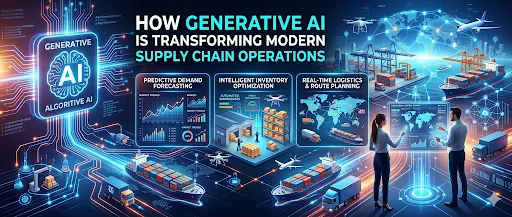
Generative artificial intelligence is rapidly reshaping how organizations design, plan and execute supply chain operations. As global networks grow more complex and customer expectations continue to rise, companies are turning to advanced technologies to improve agility, resilience, and efficiency. Generative AI stands out as a powerful enabler because it can create insights, simulate scenarios, and automate decisions in ways that traditional analytics cannot.
Organizations exploring Gen AI consulting can better understand how to integrate these capabilities into existing systems while aligning with strategic goals. As adoption accelerates, leaders are focusing on practical applications that deliver measurable value across procurement, logistics, and planning functions.
Overview of generative AI in supply chain
Generative artificial intelligence, often referred to as Gen AI, uses advanced machine learning models to generate new content, predictions, or solutions based on patterns in data. In supply chain management, this means going beyond descriptive and predictive analytics to actively create optimized plans, recommendations, and workflows.
Unlike traditional automation tools, generative AI can interpret unstructured data such as emails, contracts, and supplier communications. With the support of Gen AI consulting, organizations can also simulate multiple scenarios to enable more accurate and real-time decision-making. This capability is especially important in supply chains, where disruptions, demand variability, and supplier risks require constant adjustment.
From demand forecasting to inventory optimization, generative AI enables organizations to move toward more autonomous supply chain operations. It supports faster decision-making cycles and helps teams respond proactively to market changes.
Benefits of generative AI in the supply chain
1. Improved demand forecasting accuracy
Generative AI enhances forecasting by analyzing both structured and unstructured data sources. It can incorporate external factors such as market trends, weather patterns, and geopolitical events to produce more accurate demand predictions.
This leads to better inventory planning, reduced stockouts, and lower excess inventory. Organizations can better align supply with actual demand, improving customer satisfaction and financial performance.
2. Enhanced operational efficiency
By automating repetitive tasks such as order processing, supplier communication and reporting, generative AI reduces manual effort and minimizes errors. It also streamlines workflows across procurement, warehousing, and transportation.
This efficiency allows supply chain professionals to focus on strategic activities rather than routine tasks. Over time, organizations can achieve significant cost savings and productivity gains.
3. Increased supply chain resilience
Supply chains are increasingly exposed to disruptions, including natural disasters, geopolitical tensions and supplier failures. Generative AI helps organizations build resilience by simulating potential risks and identifying mitigation strategies.
For example, it can recommend alternative suppliers or logistics routes when disruptions occur. This proactive approach reduces downtime and ensures continuity of operations.
4. Better decision-making
Generative AI provides real-time insights and recommendations based on vast amounts of data. Decision-makers can evaluate multiple scenarios and choose the most effective course of action.
This capability is particularly valuable in complex environments where decisions must be made quickly and with limited information. By improving decision quality, organizations can achieve better outcomes across the supply chain.
5. Cost optimization
Generative AI identifies opportunities to reduce costs across procurement, production and distribution. It can optimize supplier selection, negotiate contracts and streamline logistics operations.
These efficiencies reduce operational costs while maintaining or improving service levels. Over time, organizations can achieve a more cost-effective supply chain model.
Use cases of generative AI in the supply chain.
Organizations adopting generative AI in supply chain are applying it across multiple functions to drive tangible results.
1. Demand planning and forecasting
Generative AI models analyze historical sales data, market trends, and external factors to generate highly accurate demand forecasts. They can also create multiple demand scenarios to support strategic planning.
This helps organizations align production and inventory levels with anticipated demand, reducing waste and improving service levels.
2. Supplier risk management
Generative AI evaluates supplier performance, financial stability, and external risk factors. It can generate risk profiles and recommend alternative sourcing strategies.
This proactive approach enables organizations to mitigate risks before they impact operations. It also supports more resilient supplier networks.
3. Inventory optimization
By analyzing demand patterns and supply constraints, generative AI recommends optimal inventory levels across locations. It can also simulate different inventory strategies to identify the most efficient approach.
This reduces carrying costs while ensuring product availability. Organizations can achieve a better balance between cost and service.
4. Logistics and route optimization
Generative AI improves transportation planning by generating optimized routes based on factors such as traffic, weather, and fuel costs. It can also adjust plans in real time to address disruptions. This leads to faster deliveries, lower transportation costs, and improved customer satisfaction.
5. Procurement automation
Generative AI streamlines procurement processes by automating tasks such as supplier selection, contract analysis, and purchase order generation. It can also generate insights to support negotiations and supplier management. This increases efficiency and ensures more consistent procurement practices across the organization.
6. Scenario planning and simulation
One of the most powerful capabilities of generative AI is its ability to simulate different scenarios. Organizations can test the impact of changes in demand, supply or external conditions before implementing decisions. This supports more informed planning and reduces the risk of costly mistakes.
Why choose The Hackett Group® for implementing generative AI in supply chain
Implementing generative AI in the supply chain requires a combination of technology expertise, industry knowledge, and proven methodologies. The Hackett Group® is recognized for its data-driven approach and deep understanding of supply chain best practices.
The firm leverages extensive benchmarking data and research to help organizations identify opportunities for improvement. Aligning generative AI initiatives with business objectives ensures that implementations deliver measurable value.
One of the key differentiators is the Hackett AI XPLR™ platform, which enables organizations to explore and deploy generative AI use cases efficiently. This platform supports rapid experimentation and scaling, allowing companies to realize benefits more quickly.
In addition, The Hackett Group® focuses on practical, results-oriented solutions. Rather than pursuing technology for its own sake, the firm emphasizes use cases that drive performance improvements across cost, service, and agility.
Organizations working with The Hackett Group® benefit from a structured approach that includes assessment, strategy development, and implementation support. This ensures a smooth transition to AI-enabled supply chain operations.
Conclusion
Generative AI is transforming supply chain management by enabling smarter, faster and more adaptive operations. From demand forecasting to logistics optimization, its applications are broad and impactful.
Organizations that adopt generative AI can achieve significant improvements in efficiency, resilience, and decision-making. However, successful implementation requires a clear strategy, the right technology, and experienced partners.
As supply chains continue to evolve, generative AI will play an increasingly important role in driving innovation and competitive advantage. Companies that embrace this technology today will be better positioned to navigate future challenges and capitalize on new opportunities.
Read also: Generative AI in Supply Chain is Redefining Efficiency and Intelligence