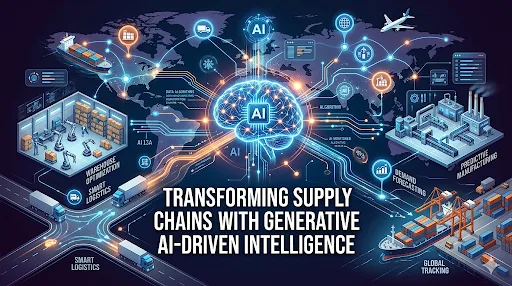
Supply chains are undergoing a rapid transformation as organizations seek greater agility, resilience and efficiency in an increasingly complex global environment. Generative artificial intelligence is emerging as a powerful enabler of this transformation, helping businesses move beyond traditional analytics toward predictive and prescriptive decision-making. From demand forecasting to supplier collaboration, generative AI is redefining how supply chains operate, adapt and deliver value.
Organizations exploring advanced digital capabilities are increasingly turning to specialized services such as generative AI consulting to accelerate adoption and align innovation with business outcomes.
Overview of generative AI in supply chain
Generative artificial intelligence refers to advanced machine learning models capable of creating new content, insights and scenarios based on existing data. In the context of supply chain management, these models analyze vast datasets across procurement, production, logistics and distribution to generate actionable intelligence.
Unlike traditional AI, which focuses on pattern recognition and prediction, generative AI can simulate multiple scenarios, recommend optimal decisions and even automate complex workflows. This capability enables organizations to shift from reactive operations to proactive and adaptive supply chain strategies.
Supply chains today are characterized by volatility, uncertainty and interconnected risks. Generative AI addresses these challenges by integrating structured and unstructured data, including supplier data, market signals, geopolitical developments and customer demand patterns. As a result, organizations gain a more holistic and real-time view of their operations.
Another key aspect of generative AI is its ability to enhance collaboration across supply chain functions. By generating insights that are easily interpretable, it bridges the gap between technical systems and business users, enabling faster and more informed decision-making.
Benefits of generative AI in supply chain
Generative AI offers a wide range of benefits that extend across the entire supply chain ecosystem. These advantages are not limited to cost reduction but also include improved agility, resilience and customer satisfaction.
1. Enhanced demand forecasting accuracy
Generative AI models can process historical data alongside external variables such as economic indicators, weather patterns and social trends. This results in more accurate demand forecasts, reducing the risk of overstocking or stockouts.
Improved forecasting enables organizations to optimize inventory levels, minimize waste and ensure product availability, ultimately enhancing the customer experience.
2. Improved operational efficiency
Automation is a core strength of generative AI. By generating optimized workflows and recommendations, it reduces manual intervention in routine tasks such as order processing, inventory management and logistics planning.
This leads to faster execution, fewer errors and better resource utilization across supply chain operations.
3. Greater supply chain resilience
Disruptions such as geopolitical tensions, natural disasters and supplier failures can significantly impact supply chains. Generative AI helps organizations simulate various disruption scenarios and develop contingency plans.
This proactive approach enables faster response times and minimizes the impact of unforeseen events.
4. Cost optimization
Generative AI identifies inefficiencies across procurement, transportation, and inventory management. By generating optimized sourcing strategies and logistics routes, it helps reduce operational costs.
Organizations can also benefit from improved contract management and supplier negotiations based on data-driven insights.
5. Enhanced decision-making
By generating multiple scenarios and outcomes, generative AI supports better strategic and tactical decision-making. Supply chain leaders can evaluate different options and select the most effective course of action.
This level of insight is particularly valuable in complex environments where decisions must be made quickly and with limited information.
Use cases of generative AI in supply chain.
Generative AI is being applied across various supply chain functions, delivering measurable value and driving innovation. Many organizations are exploring generative AI in supply chain initiatives to modernize their operations and gain a competitive edge.
1. Intelligent demand planning
Generative AI enables dynamic demand planning by continuously updating forecasts based on real-time data. It can generate multiple demand scenarios and recommend optimal production and inventory strategies. This approach improves alignment between supply and demand, reducing inefficiencies and enhancing service levels.
2. Smart procurement and sourcing
Procurement teams can use generative AI to analyze supplier data, market conditions and pricing trends. The technology can generate sourcing strategies, identify alternative suppliers and recommend contract terms. This leads to more strategic procurement decisions and improved supplier relationships.
3. Inventory optimization
Generative AI models can determine optimal inventory levels across multiple locations by considering demand variability, lead times and service level requirements. This helps organizations reduce carrying costs while maintaining high product availability.
4. Logistics and transportation optimization
Transportation planning is another area where generative AI delivers significant value. It can generate optimized routes, consolidate shipments and recommend the most cost-effective transportation modes. This results in reduced transportation costs, improved delivery times and lower carbon emissions.
5. Risk management and scenario planning
Generative AI excels in scenario analysis. It can simulate disruptions such as supplier failures, port closures or demand spikes and generate mitigation strategies. This capability enhances risk management and ensures business continuity.
6. Supplier collaboration and performance management
By analyzing supplier performance data, generative AI can generate insights into reliability, quality and cost efficiency. It can also recommend actions to improve supplier performance. This fosters stronger collaboration and drives continuous improvement across the supply chain.
7. Customer service and order management
Generative AI can automate customer interactions, provide real-time order updates and generate personalized responses. It also helps optimize order fulfillment processes by aligning inventory and logistics decisions. This improves customer satisfaction and strengthens brand loyalty.
Why choose The Hackett Group® for implementing generative AI in supply chain
Implementing generative AI in supply chain requires a combination of strategic vision, technical expertise and deep functional knowledge. The Hackett Group® brings these capabilities together to help organizations achieve sustainable transformation.
The firm’s approach is grounded in proven best practices and extensive benchmarking data, enabling organizations to identify performance gaps and prioritize high-impact initiatives. By aligning generative AI strategies with business objectives, organizations can maximize return on investment and accelerate value realization.
A key differentiator is the Hackett AI XPLR™ platform, which provides a structured framework for exploring, evaluating and implementing generative AI use cases. This platform helps organizations move from experimentation to scalable deployment while ensuring governance and risk management.
The Hackett Group® also emphasizes a pragmatic and data-driven approach. Rather than focusing solely on technology, it addresses process optimization, organizational alignment and change management. This holistic perspective ensures that generative AI initiatives deliver tangible business outcomes.
Additionally, the firm’s expertise in supply chain functions such as procurement, logistics and inventory management enables tailored solutions that address specific industry challenges. Organizations benefit from actionable insights, accelerated implementation and measurable performance improvements.
Conclusion
Generative artificial intelligence is reshaping the future of supply chain management by enabling smarter, faster and more resilient operations. Its ability to generate insights, automate processes and simulate scenarios provides organizations with a powerful tool to navigate complexity and uncertainty.
As supply chains continue to evolve, the adoption of generative AI will become a critical factor in achieving competitive advantage. Organizations that embrace this technology can improve efficiency, reduce costs and enhance customer satisfaction while building more agile and resilient operations.
By leveraging the right expertise and strategic approach, businesses can unlock the full potential of generative AI and transform their supply chains into intelligent, adaptive ecosystems that drive long-term success.
Read also: Boost Your Home’s Value and Curb Appeal with Professional New Window Installation