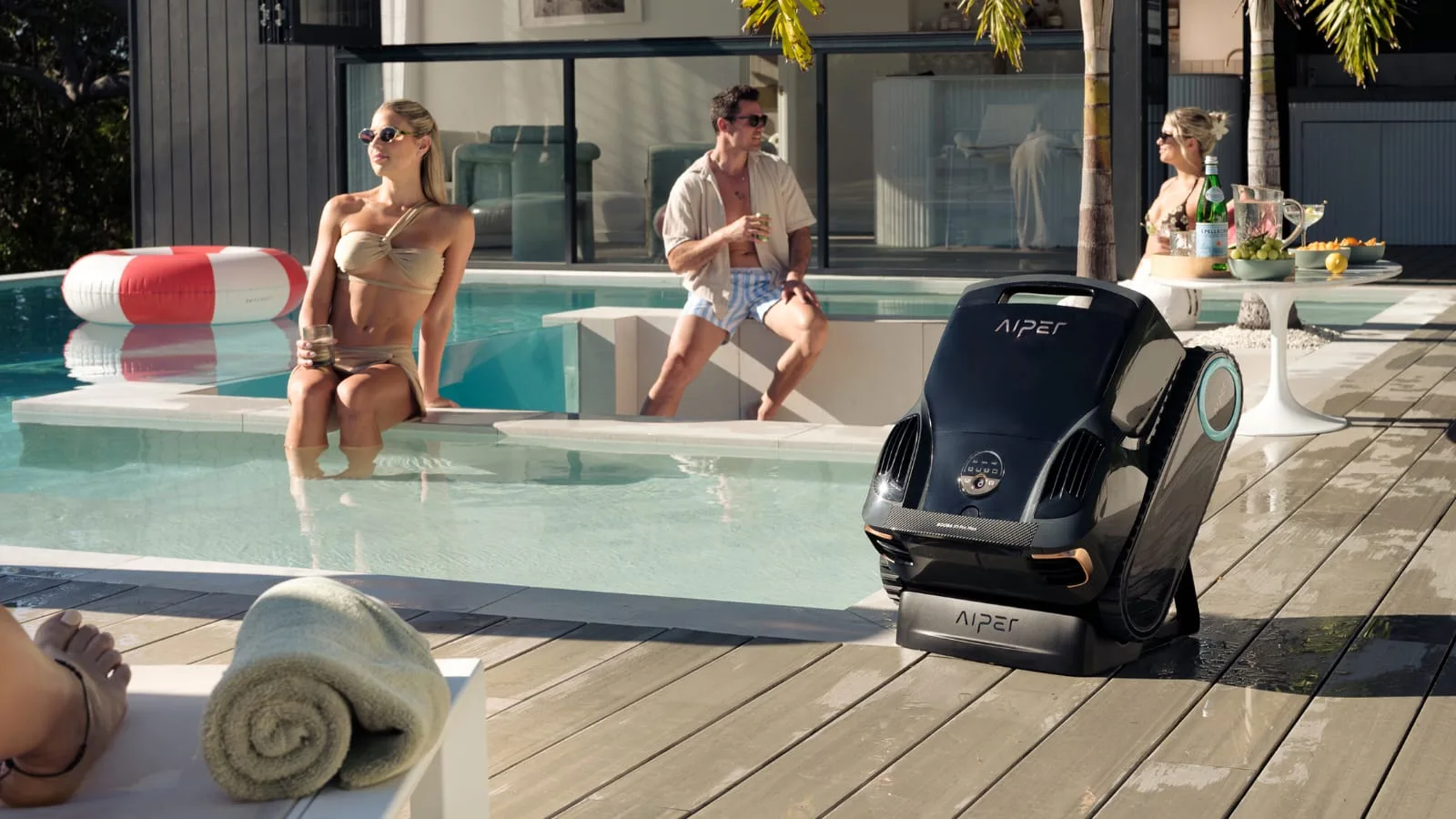
The architectural design of the backyard swimming pool has shifted away from the standard, rigid rectangle. Modern homeowners increasingly favor free-form designs, choosing kidney shapes, sweeping oasis curves, natural lagoon layouts, and integrated rock grottos.
While these organic shapes effortlessly mimic nature and create stunning visual landscapes, they also introduce a severe logistical nightmare for automated maintenance. The wild curves, acute corners, and unpredictable depth transitions absolutely destroy the internal logic of traditional extraction hardware.
If you drop an older, “blind” machine into a free-form pool, its simple navigation algorithm instantly falls apart. These older units rely on basic mechanical deflection; they drive until they hit a physical wall, back up, turn at a pre-set angle, and drive forward again.
In a perfectly square pool, this random bouncing eventually covers the entire floor. However, in a heavily curved pool, a blind machine will hit a convex wall, slide sideways along the slippery plaster, and completely lose its directional bearing.
It often gets hopelessly trapped in a tight, curved alcove, spending its entire battery life scrubbing the exact same ten square feet of plaster while entirely ignoring the deep end. To guarantee complete floor coverage without constantly babysitting the equipment, you must abandon random navigation and rely on a smart robotic pool cleaner to actively map and memorize the chaotic geometry of your specific pool.
The Mechanics of Digital Spatial Awareness
To clean a complex shape efficiently, the hardware must first understand exactly where it is within the water column. Advanced extraction equipment achieves this by swapping basic bumper switches for highly sensitive internal gyroscopes, digital accelerometers, and acoustic depth sensors.
When you first deploy the machine, it does not immediately begin vacuuming in random directions. Instead, it executes an exploratory perimeter run.
The hardware tracks along the outermost edge of the plaster, actively recording every sweep, sharp turn, and sudden drop-off. By analyzing the time it takes to travel and the angle of its internal gyroscope, the onboard processor constructs a precise digital map of the pool’s irregular footprint.
Once this invisible digital boundary is established, the machine shifts its strategy. Instead of bouncing off the walls, it uses the map to calculate the most efficient internal route, typically utilizing a systematic, overlapping grid pattern. I
t drives in perfectly straight, parallel lines from one curved edge to the other. Because it knows exactly where the opposing wall is located, it slows down just before impact, turns efficiently, and overlaps its previous path by a few inches, ensuring that not a single square inch of the organic shape is missed.
Customizing the Path for Specialized Features
While the internal processor handles the heavy lifting of the pathfinding, the homeowner still plays a crucial role in calibrating the software.
Modern free-form pools are rarely just deep holes filled with water; they are multi-tiered aquatic environments packed with specialized architectural features. A digital map is only as effective as the physical parameters you set within the companion smartphone application.
Understanding how your hardware interacts with these specific design elements allows you to customize the route and prevent frustrating operational errors.
| Architectural Feature | Navigational Challenge | Software/Route Customization |
| Zero-Depth Beach Entries | The machine drives up the gentle slope until the intake ports breach the surface, causing the motor to suck in air and physically beach the unit on the dry deck. | Draw a strict virtual “no-go” boundary across the shallowest edge of the entry, forcing the machine to turn around before the water becomes too shallow to operate. |
| Baja Shelves / Tanning Ledges | Shelves sit in very shallow water. The machine may climb the wall and get stranded on the flat ledge, unable to find its way back down to the deep end. | Restrict the machine strictly to “Floor Only” mode when the shelf is heavily populated with lounge chairs, or map the ledge as a completely separate, manual cleaning zone. |
| Tight Deep-End Grottos | Overhanging rock formations can confuse the gyroscope, and the extreme bowl shape of the hopper makes turning incredibly difficult for the heavy drive tracks. | Utilize an “Intensive Cleaning” or “Deep End Focus” routing option. This commands the machine to spend extra time aggressively overlapping its path in the deepest, most complex zone. |
Addressing the Failsafes and Entrapment Hazards
Even with a perfect digital map, a free-form pool presents unique physical entrapment hazards that you must proactively manage. The sweeping curves naturally dictate where water currents flow, which means heavy debris—and sometimes your cleaning hardware—can be pushed into specific architectural traps.
To ensure your customized route executes flawlessly every single time, you must prepare the physical environment before pressing the start button:
- Manage the Main Drain Covers: Free-form pools often feature dual, anti-entrapment main drains situated at the lowest point of the deep bowl. These covers are heavily domed. If the machine approaches the dome from a highly acute angle created by a nearby curved wall, it can high-center its chassis directly on top of the plastic drain. Ensure your machine’s route is set to approach these drains straight on, or manually increase the suction power setting to provide the lift needed to glide safely over the dome.
- Standardize the Starting Point: For the machine to properly orient its saved digital map to the physical world, you should always drop it into the water from the exact same location on the pool deck. If you drop it in the deep end on Monday, and the shallow end on Thursday, the internal gyroscope must spend valuable battery life re-orienting itself and recalibrating the map against its stored memory.
- Clear the Wedding Cake Steps: Sweeping, multi-tiered corner steps are a massive friction point. If the machine’s route includes wall climbing, ensure that floating chlorine dispensers, pool noodles, and dive rings are completely removed from the step area. A machine mapping a complex corner will instantly abort its programmed path if it collides with a heavy, waterlogged toy resting on the second step.
The Material Benefit of Systematic Grids
The ultimate payoff of utilizing digital mapping in a free-form environment goes beyond just a visually clean floor; it directly impacts the longevity of your pool’s interior finish. When an older, random-bouncing machine gets trapped in a tight, curved cove, its heavy rubber tracks spend an hour endlessly grinding against the exact same patch of delicate plaster or vinyl.
Over several seasons, this repetitive mechanical friction physically wears away the protective surface of the pool floor, leaving rough, porous patches that invite aggressive algae growth.
By customizing a highly systematic, mapped route, you completely eliminate this localized wear and tear. The machine visits every single curved alcove, tight corner, and deep hopper exactly one time per cycle. It sweeps the dirt, filters the water, and immediately moves on to the next sector.
By embracing the power of spatial awareness and taking five minutes to carefully calibrate your digital boundaries, you effortlessly tame the chaotic geometry of your free-form pool. This ensures a pristine swimming environment without ever subjecting your expensive plaster to unnecessary mechanical abuse or wasted battery life.
Read also: Blue Velvet Sofa: How to Style It in Modern Living Rooms (2026 Guide)