In the history of American political life, some families go to the top and become prominent due to their service to the people and influence in communities.
The Ford family of Tennessee is one such dynasty and at the center of this legacy, a woman who opted to be influential rather than to be in the limelight, is her name; Dorothy Bowles Ford.
Being the ex-wife of Harold Ford Sr., the first African-American congressman of Tennessee and the mother of Harold Ford Jr., who took up the path of his father, the story of Dorothy is a quiet narration of professional success and uncompromising devotion to the family.
Childhood and Reign of Memphis Roots
Dorothy Bowles Ford was born circa 1949 in Memphis, Tennessee, at the time, when the American society was undergoing a revolution. Being raised in Memphis, it was possible to see with your own eyes what the Civil Rights Movement went through and what it achieved.
The place where blues music was born and where a social change was cooked was the city that formed the world view of Dorothy and gave her the principles that were to shape her future view of the family and community.
As a city in her early years, Memphis was struggling with segregation, but at the same time it is a city with the Civil Rights Movement, which made a significant impact on her perception of social justice and civic duty.
Education, hard work and integrity were the core values of her upbringing and she would adhere to them in the whole of her life and teach them to her children.
Although information about her parents, simply called Mr. and Mrs. Bowles is mostly confidential, it is evident that they had deeply embedded in the young Dorothy a high standard of values that focused on education and serving the society.
This would form a solid background when she joined one of the biggest political families in Tennessee.
A Historic Marriage: Construction of a Political relationship
On February 10, 1969, Dorothy Bowles Ford wed Harold Eugene Ford Sr. and they started working together that would last three decades and change the face of Tennessee politics forever. Harold Ford Sr., would become the first African-American to serve the U.S. Congress, representing Tennessee in his ten-year term between 1975 and 1997 in the 9th congressional district in Tennessee, which included Memphis.
The marriage was a timely one- Harold Sr. was turning his back on the family funeral business and into politics and the backing of the family would be the key to his success. The U.S.
House of Representatives archives report that Dorothy has been a longtime worker in the U.S. Department of Agriculture but other sources report that she worked at Potomac Electric Power Company, which indicates her diverse work experience.
Being the wife of the revolutionary politician, Dorothy had to find her way in the world of political life with dignity and will. She assisted in campaigning work and ensured stability at home and served as the organization foundation through which her husband was able to concentrate on his legislative work.
This was not a petite accomplishment especially during the 1970s and 1980s when African-American political families were under different pressure and scrutiny.
Professional Career: More Than a Political Spouse
Dorothy Bowles Ford never was satisfied just to be categorized by the occupation of the spouse. She made her own professional identity and this portrays that she was a competent and successful person in her own ways.
Dorothy was an administrator and a coordinator of consumer and regulator operations of Potomac Electric Power Company in Washington, D.C. In this position, she had to do administrative work, maintain contacts with regulatory bodies, and adhere to a number of regulations.
Her job demanded detailed attention, good interpersonal skills and capability of operating within complex regulatory conditions.
Dorothy also served in the congressional office of Harold Ford Sr., in which her abilities in administration and organization contributed to a large extent in the running of the office smoothly and efficiently.
This was a two-fold position since she had to pursue her own career as well as serve her husband in his political aspirations, which best illustrated the juggling act that a number of political wives had to undertake.
Her career in the profession interacted with the public service in a significant manner. She was not merely playing behind the scenes but she was contributing towards the systems serving consumers and constituents.
This practical encounter into regulatory processes and customer advocacy would be used subsequently to guide her values with her children as to service to others.
Motherhood and Family: Bringing up the Next Generation
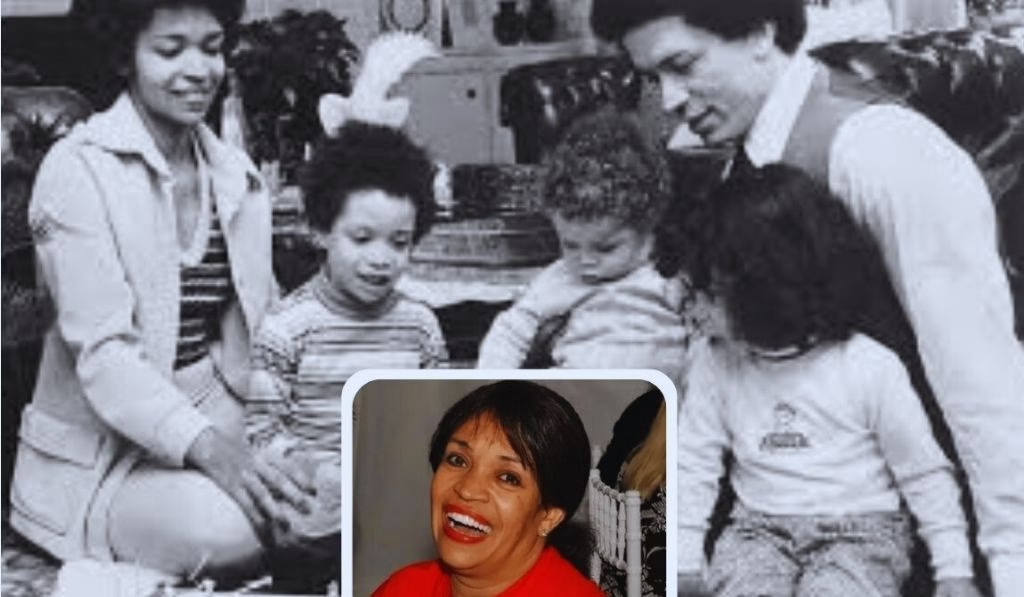
The legacy that Dorothy has left that can be lasting is that of a mother. The two had three sons, Harold Ford Sr., and Harold Ford Jr.:
- Harold Eugene Ford Jr. (born May 11, 1970) -The eldest and would succeed his father in politics.
- John Newton Ford (Jake) -Named after his grandfather, Newton Jackson Ford
- Sir Isaac Ford -The third son of the three brothers.
During the first swearing-in of their son in Capitol Hill, young Harold Jr. raised his hand and as Dorothy recalls, claimed, This is what I want to be when I grow up, a remark that not only predicted his future political career but also showed the great impact of his brought up daughter.
Bringing up children in a political family was not an easy task. The Ford family was in the limelight of society and could be both admired and criticized. Dorothy did this to ensure that her sons were able to get a sense of normalcy but at the same time ready them to assume the duties that would come with their family name.
She stressed on education, integrity and the value of serving the people, which would lead the lives of all her three sons.
Their relocation to Washington, D.C. in the late 1970s when Harold Sr. was elected to Congress, subjected the children to a new world.
Harold Jr. spent his time at the prestigious St. Albans School of Boys in Washington which played a future role in his political thought and coalition-building methods in various communities.
Harold Ford Jr.: The Role of the Mother on Political Legacy
The result of the parenting by Dorothy may best be seen through the career of his eldest son, Harold Ford Jr. Harold Jr. had served in the United States House of Representatives since 1997 in the same congressional district that his father had served for 22 years.
Harold Jr. was in the University of Michigan pursuing his legal studies when Harold Sr. chose not to take a twelfth term in 1996.
To campaign, he would have his class schedule such that he would fly home to Memphis during long weekends and with the same schedule, he would work hard and be dedicated to his work, and this is a demonstration of the work ethic and dedication that his mother had earned in him.
Harold Jr. was elected into Congress as one of the youngest members in the United States of America. His political approach that was marked with moderation, cross-party cooperation, and focus on practical solutions were characteristic of the values that Dorothy stressed on: integrity, education, and service to people.
Harold Jr. did not limit himself to Congress. He was a chairman of Democratic Leadership Council and was later employed as a financial managing director at Morgan Stanley.
He was also a political commentator and an author of More Davids Than Goliaths: A Political Education and he would be a Fox News political contributor. In all these transitions, the base that Dorothy had given him was reflected in his style of addressing people and leadership.
Life After Divorce: Remaining Gracious and Dignified
In 1999, Dorothy and Harold Ford Sr. ended their marriage of thirty years in divorce. Dorothy went through this process with the same grace and dignity with which she had dealt with her official life, and the divorce put a close to a very important phase in both their lives.
Even after the marriage was over, Dorothy continued to use the Ford name as a sign that she will always be associated with the efforts the family made in American politics.
She still maintained her interest in her relationship with her children offering them stability and direction as they crossed their own path.
Harold Ford Sr. married later Michelle Roberts and had two more children with her, Andrew and Ava. The sons of Dorothy, therefore, had two half-siblings and Dorothy settled in her new family atmosphere without abandoning her position as a caring mother.
After the divorce, Dorothy Bowles Ford decided to lead a more anonymous life. She is said to be living in New York City where Harold Jr. and his family are near but has been in the background.
The choice is indicative of her lifetime preference of being influenced over publicized, of being full of substance over being a celeb.
The Ford Political Dynasty: Family Law
In order to realize the meaning of Dorothy, one has to appreciate the full magnitude of the political influence by the Dorothy Bowles Ford family in Tennessee. Harold Ford Sr. was the 15th born in a family of 15 children of Newton Jackson Ford, the owner of N.J. Ford and Sons Funeral Home, a respected enterprise in the African American community in Memphis.
The politics of the Ford family goes back several generations. The father of Harold Sr. is Newton Jackson Ford, who served as a county squire in 1888-1900.
When Harold Sr. became a congressman in 1974, his brothers Emmitt and John Ford were also elected to the Tennessee general assembly and this formed a political family that would shape the politics of Memphis and Tennessee over the next few decades.
In this family Dorothy joined not only its excellent business but also its political traditions and she was a vital factor in its further prosperity.
Her work behind the scenes, and her contributions to the company, more importantly, her part in bringing up the next generation of Ford leaders, also meant that the family heritage of serving the people would not be lost.
Values and Principles: What Dorothy Believed In
Dorothy Bowles Ford has thus been described as having the following principles throughout her life:
Education as Groundwork:
Dorothy realized that education was the opportunity and the stepping stone. She spent much time guaranteeing the best education possible to her sons as Harold Jr. had studied at St. Albans, at the University of Pennsylvania and the University of Michigan Law School.
Service to Community:
either in her professional practice in consumer advocacy or by supporting the political career of her husband, Dorothy was always dedicated to serving people and her community.
Integrity and Dignity:
Dorothy was graceful even in the hardest moments of her life like when her husband was indicted in a bank fraud case (which he was later acquitted) and when they finally divorced.
Quiet Strength:
Another attribute that defines Dorothy Bowles Ford is that as much as she likes to work behind the scenes instead of gaining publicity. It is precisely this fact that has made her influence far-reaching because it was based on substance, not publicity.
Current Life and Legacy
In 2024, the age of Dorothy Bowles Ford is estimated at the middle of her 70s. She has still managed to keep her privacy and at the same time stay in touch with her family.
Harold Jr. is married to Emily Threlkeld, and she has two children, namely, daughter Georgia Walker Ford and son Harold Eugene Ford III making Dorothy a grand-mother whose family heritage has lasted to a fourth generation.
Harold Eugene Ford III, the grandson of Dorothy continues not only a name but also the ideals that she had been fighting her entire life. All these continue to carry the Ford family under the focus of education, public service and civic responsibility which is a tribute to the legacy that Dorothy contributed to.
Although Dorothy herself has been comparatively underestimated and relatively unrecognized in terms of media attention and similar fame, the one who is familiar with the history of the Ford family knows that she was the heart of it all.
She is representative of the thousands and thousands and thousands of people, especially women, especially women of color who have influenced the history of American politics in one way or another as they stood behind the scenes, gave guidance, and support even though their contributions often go unrecognized.
The Higher Context Women in political families

The story of Dorothy is in a greater narrative of the role of women in American political families especially the African-American women during the civil rights and post-civil rights era.
These women were mostly expected to balance a lot of responsibilities: their own careers, taking care of the households, having to promote the political aspirations of their husbands, raise their children in front of the media focus, and represent their communities.
African-American political families had the additional pressures of systemic racism in addition to the normal challenges of being in the politics of the people as well as the pressure of representing their communities in the political arena that was predominantly white.
Dorothy has overcome these obstacles in the course of creating one of the most significant African-American political dynasties in the history of Tennessee.
Her style, professional success and family commitment, fame and privacy, is a template on how people can be very influential without wanting to be noticed. It is Dorothy who teaches us that, in an age where personal branding and seeming like a celebrity are all the rage, some of the most valuable work is often secret.
Lessons from Dorothy’s Life
Lessons: A number of lessons may be learned out of the story of Dorothy Bowles Ford:
- Influence Doesn’t Need Fame: The role that Dorothy has played in the American political arena, whether through her sons or in her support through the husband, has been significant despite her liking privacy. Influence is not a matter of publicity, but results.
- Professional Identity Matters: Dorothy continued to have a career and professional identity despite assisting her husband in his politics. This empowerment helped her and her marriage and also her ego.
- Values Are Generational: Dorothy has been keen on education, integrity and serving the people of her country which has passed on to the generations and this has molded not only her sons but also her grandchildren.
- Grace Under Pressure: Dorothy stood tall under the pressure of her legal problems with her husband, a high-profile divorce, or the pressure of political life, she always remained dignified and calm.
- Family First: Regardless of the urgency of her political life and professional duties, Dorothy still centered most of her attention on her children and making sure they could have the basis to succeed.
Debate: The Unsent Matriarch
The life of Dorothy Bowles Ford provides an interesting image of an American woman who preferred substance over celebrity, influence over fame.
She has assisted in the creation and the development of one of the most significant political families in Tennessee, gave birth to a son who was a national political figure, and retained her own professional identity all along.
The history of American politics is full of glorifying the people who are in office, who give speeches, and whose names are placed on the ballot.
But behind a large number of these names are relatives – espoused especially by mothers – who form leaders, on whom careers are made, and on which values the name of a leader rests. One such character is Dorothy Bowles Ford.
The story of her is to remind us that the history of politics is not only in congress rooms and political campaign trails but also in family backgrounds, in kitchen tables and through the work of inoculating the future generation with moral principles.
Dorothy lives on in her sons, her grandchildren and how the Ford family continues to influence Tennessee and American politics.
When we consider the life of Dorothy Bowles Ford and her works, we have a better idea of the kind of political dynasties forming around us, not only with the drive of ambition and talent, but also with the silent might, commitment and values of a person such as Dorothy making history. It is worth telling, remembering, and celebrating her story as a critical component of American history in the political arena.