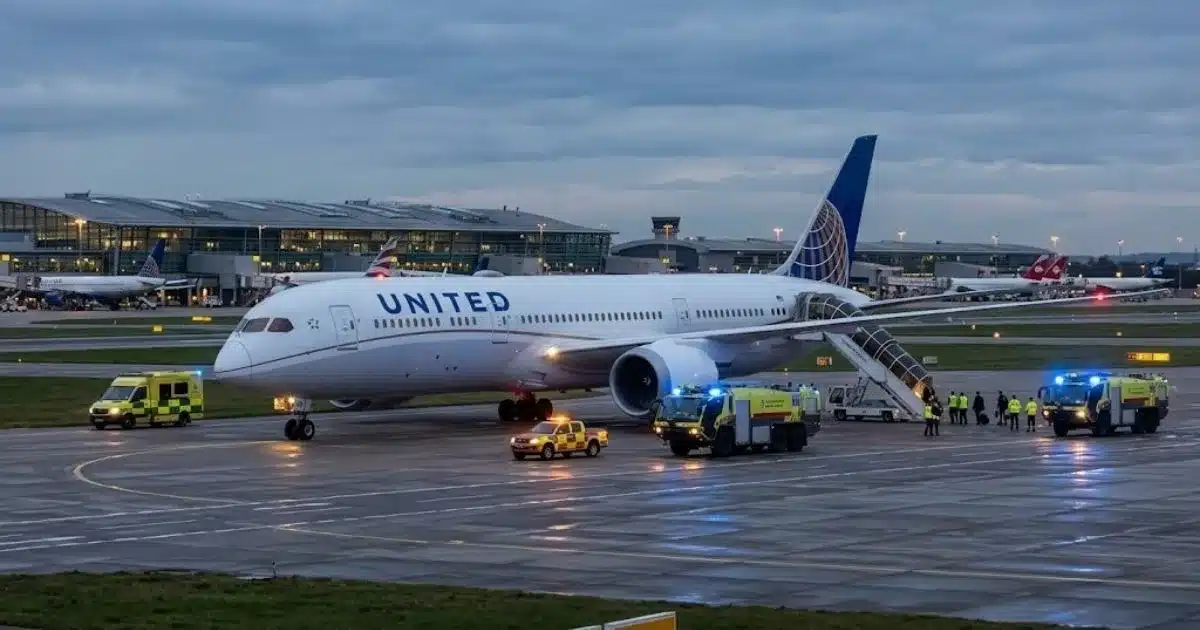
Few events in commercial aviation generate as much public curiosity as an in-flight emergency diversion. The United Airlines flight UA770 emergency diversion became one of the most searched aviation incidents of 2025, appearing across news outlets, aviation forums, and social media platforms throughout the year.
What makes the United Airlines flight UA770 emergency diversion particularly unusual is that it is not one single event. Multiple incidents connected to this flight number occurred across different routes, different aircraft, and different technical circumstances during 2025. Each instance of the United Airlines flight UA770 emergency diversion ended with the same outcome: all passengers and crew landed safely with no reported injuries.
his guide covers the complete story clearly, from the aircraft involved and the routes affected to the technical causes, emergency protocols followed, passenger rights, and the broader lessons this series of incidents offers about modern aviation safety.
What Is the United Airlines Flight UA770 Emergency Diversion?
The United Airlines flight UA770 emergency diversion refers to a series of unplanned in-flight diversions connected to the UA770 flight number across different dates in 2025. Flight UA770 is a regular scheduled service operated by United Airlines, one of the largest commercial carriers in the United States.
The route most frequently associated with the United Airlines flight UA770 emergency diversion runs from Barcelona El Prat Airport in Spain to Chicago O’Hare International Airport in Illinois. However, at least one additional incident under the UA770 flight number involved a San Francisco to Chicago routing that diverted to Denver.
Each instance of the United Airlines flight UA770 emergency diversion resulted in a safe landing at an alternate airport. The flight number became a focal point in aviation safety discussions precisely because it appeared in multiple separate incidents over a relatively short period.
The Aircraft: Boeing 787-8 and 787-9 Dreamliner
The aircraft at the centre of the most widely reported United Airlines flight UA770 emergency diversion incidents are variants of the Boeing 787 Dreamliner, one of the most technologically advanced commercial aircraft currently in operation. Specifically, the May and July 2025 diversions involved Boeing 787-9 and Boeing 787-8 models. The registration number N26902 has been linked to the aircraft involved in the Barcelona to London diversion.
The Boeing 787 Dreamliner is constructed with advanced composite materials, highly automated onboard systems, and extensive redundancy across its critical mechanical and electrical systems. These features make it one of the safest long-haul aircraft ever built. The United Airlines flight UA770 emergency diversion incidents demonstrate that even on the most sophisticated aircraft, monitoring systems can detect anomalies that warrant precautionary action.
Incident One: May 27, 2025 — Barcelona to London Heathrow
The first major United Airlines flight UA770 emergency diversion to attract widespread attention occurred on 27 May 2025. The flight departed Barcelona El Prat Airport as a scheduled transatlantic service to Chicago O’Hare. Approximately 90 minutes after takeoff, while cruising at approximately 37,000 feet over the Atlantic, the flight crew detected irregular readings in the aircraft’s cabin pressurisation system.
The cabin pressurisation system is a critical component of any commercial aircraft. It maintains stable air pressure inside the cabin at altitude, ensuring that passengers and crew receive sufficient oxygen without the need for supplemental equipment. The readings detected during the United Airlines flight UA770 emergency diversion on this date did not escalate to an actual loss of pressure.
Oxygen masks were not deployed. However, the pilots treated the alert as a potentially serious situation requiring immediate precautionary action. The crew activated Squawk 7700, the universal aviation emergency transponder code, notifying air traffic control of the declared emergency.
A diversion to London Heathrow Airport was requested and approved. The aircraft landed safely at Heathrow with no injuries reported. The affected aircraft, registered as N26902, was subsequently grounded for thorough technical inspection.
Incident Two: July 2025 — Barcelona to Chicago, Diversion to London
A second United Airlines flight UA770 emergency diversion occurred in July 2025, again on the Barcelona to Chicago route. Squawk Alert, an aviation monitoring service, posted real-time notification of the event on social media, confirming that the UA770 aircraft, identified as a Boeing 787-8 Dreamliner with registration N26902, had declared an emergency and was diverting to London.
This United Airlines flight UA770 emergency diversion followed a pattern consistent with the May incident. The crew acted swiftly following the detection of an onboard technical issue. Air traffic control was notified through the established emergency declaration procedure. The diversion to London was executed smoothly, and all passengers disembarked safely at Heathrow.
United Airlines provided meal vouchers to affected passengers and rebooked them on alternative flights to Chicago. The airline’s response to this United Airlines flight UA770 emergency diversion was widely noted as professional and efficient by aviation observers.
Incident Three: July 28, 2025 — San Francisco to Chicago, Diversion to Denver
A third incident associated with the UA770 flight number occurred on 28 July 2025. On this occasion, the United Airlines flight UA770 emergency diversion involved a service operating from San Francisco International Airport to Chicago O’Hare. During the flight, while crossing over the Rocky Mountains, the pilots received a warning related to the aircraft’s hydraulic system.
The hydraulic system is one of the most critical mechanical systems on any commercial aircraft. It controls the operation of flight control surfaces, landing gear deployment, and braking systems. A hydraulic warning is treated with the highest level of operational seriousness within aviation safety protocols. The crew of this United Airlines flight UA770 emergency diversion declared an emergency and diverted to Denver International Airport.
The landing at Denver was smooth and controlled. No passengers or crew were injured. The incident reinforced the pattern of professional, protocol-driven responses associated with every United Airlines flight UA770 emergency diversion event throughout 2025.
The Role of Squawk 7700 in the UA770 Diversions
Every United Airlines flight UA770 emergency diversion that involved a declared emergency activated Squawk 7700, the internationally recognised aviation transponder code for a general in-flight emergency. Understanding this code is important for anyone seeking to understand how aviation emergencies are managed.
A transponder is a device aboard every commercial aircraft that broadcasts the aircraft’s identity, altitude, and flight status to air traffic control radar systems. The standard operating code for a routine flight is 7600 for communication failure or 7500 for hijacking. Squawk 7700, broadcast during the United Airlines flight UA770 emergency diversion events, immediately alerts all air traffic controllers tracking the aircraft that an emergency has been declared.
This triggers a priority response across all relevant air traffic management systems. Airspace is cleared, emergency services at the destination airport are placed on standby, and expedited routing is provided. The activation of this code during each United Airlines flight UA770 emergency diversion allowed the crew to receive immediate priority handling throughout the diversion process.
How the United Airlines Crew Responded
The flight crews involved in each United Airlines flight UA770 emergency diversion followed standardised emergency procedures with consistent professionalism. Aviation emergency response begins with recognition: the crew identifies the anomaly through instrument readings, system alerts, or observable symptoms.
Assessment follows: the pilots evaluate the severity of the issue against established checklists and determine the appropriate course of action. Decision-making is the third stage: the crew determines whether to continue to the original destination, divert to a nearby suitable airport, or in extreme cases consider immediate landing at the nearest available runway.
In every United Airlines flight UA770 emergency diversion, the crews chose precautionary diversion to a fully equipped major international airport capable of providing comprehensive emergency support. Communication with passengers was maintained throughout each United Airlines flight UA770 emergency diversion, with the cabin crew managing passenger wellbeing calmly and effectively. No serious passenger distress incidents were reported in connection with any of the diversions.
Comparison: UA770 Diversions Side by Side
| Feature | May 2025 Diversion | July 2025 (BCN-ORD) | July 28, 2025 (SFO-ORD) |
| Route | Barcelona to Chicago | Barcelona to Chicago | San Francisco to Chicago |
| Diverted To | London Heathrow | London Heathrow | Denver International |
| Aircraft Type | Boeing 787-9 Dreamliner | Boeing 787-8 Dreamliner | Not confirmed |
| Technical Issue | Cabin pressurisation | Cabin pressurisation | Hydraulic system warning |
| Squawk Code | 7700 | 7700 | 7700 |
| Injuries | None | None | None |
| Passenger Compensation | Vouchers and rebooking | Vouchers and rebooking | Rebooking arranged |
Passenger Rights Following an Emergency Diversion
The United Airlines flight UA770 emergency diversion series raised legitimate questions among affected passengers about their rights under aviation regulations. These rights vary depending on the route affected and the regulatory framework that applies.
For the Barcelona to London diversions, EU Regulation EC 261/2004 applies because the flights originated within the European Union. This regulation provides passengers with specific entitlements when flights are significantly delayed or diverted.
Passengers affected by the United Airlines flight UA770 emergency diversion who experienced delays of three hours or more at their final destination may be entitled to compensation ranging from EUR 300 to EUR 600, depending on the distance of the route. However, airlines can invoke an exemption for extraordinary circumstances beyond their control, such as genuine safety-related mechanical issues.
The specific circumstances of each United Airlines flight UA770 emergency diversion would determine whether this exemption applies. Regardless of compensation eligibility, United Airlines was obligated to provide meals, refreshments, and rebooking assistance to all passengers affected by each diversion. Reports indicate the airline fulfilled these obligations in each case.
For passengers affected by the San Francisco to Denver diversion, US Department of Transportation regulations govern passenger rights. Under these rules, airlines must provide passengers with timely information about the cause of delays and diversions and must arrange rebooking on the next available flight at no additional cost.
Why the UA770 Flight Number Became a Search Phenomenon
The United Airlines flight UA770 emergency diversion became one of the most searched aviation phrases of 2025 for reasons that go beyond the incidents themselves. Several factors combined to amplify public interest in the United Airlines flight UA770 emergency diversion beyond its individual significance.
First, multiple separate incidents sharing the same flight number created a perception of concentrated risk around a single flight designation. In reality, flight numbers rotate across different aircraft and different days, meaning three incidents under the UA770 number do not indicate any persistent fault with a single aircraft.
Second, the real-time broadcasting of Squawk 7700 activations by aviation monitoring services like Squawk Alert meant that each United Airlines flight UA770 emergency diversion was immediately and publicly visible online as it happened. Third, the Barcelona to Chicago route is one of the more heavily travelled transatlantic services, meaning a larger pool of potential passengers, family members, and industry observers was naturally interested in each United Airlines flight UA770 emergency diversion event.
What Cabin Pressurisation Issues Actually Mean
The most common technical cause cited across the United Airlines flight UA770 emergency diversion incidents is a cabin pressurisation system anomaly. Understanding this system helps place the seriousness of each diversion in proper context. Commercial aircraft fly at altitudes between 30,000 and 40,000 feet, where ambient air pressure is insufficient to sustain human life without assistance.
The pressurisation system artificially maintains cabin air pressure equivalent to approximately 6,000 to 8,000 feet of altitude, which is comfortable and safe for passengers. If this system develops irregular readings, the standard aviation safety response is precautionary diversion regardless of whether an actual pressure loss has occurred.
In the United Airlines flight UA770 emergency diversion events attributed to pressurisation, the system’s readings were abnormal but the pressure itself was not lost. Oxygen masks were not deployed in any of the reported incidents. The decision to divert reflected the crew’s application of the principle that any uncertainty about a critical safety system must result in the most conservative available response.
United Airlines’ Safety Record and Response to UA770
United Airlines is one of the largest commercial carriers in the world, operating hundreds of flights daily across domestic and international routes. The United Airlines flight UA770 emergency diversion incidents represent a small fraction of the airline’s overall operational activity but received disproportionate attention due to the circumstances described above.
United Airlines responded to each United Airlines flight UA770 emergency diversion by grounding the affected aircraft for technical inspection, arranging passenger rebooking and compensation, and cooperating with aviation safety investigators.
The airline’s transparent and professional handling of each United Airlines flight UA770 emergency diversion is consistent with its status as a carrier operating under the oversight of the Federal Aviation Administration in the United States and relevant European aviation authorities for its EU-originating flights. No regulatory action or enforcement findings have been publicly reported in connection with any United Airlines flight UA770 emergency diversion incident.
Lessons From the United Airlines Flight UA770 Emergency Diversion Series
The United Airlines flight UA770 emergency diversion series offers several valuable lessons for passengers, aviation professionals, and policy makers.
For passengers, the incidents demonstrate that modern commercial aviation’s safety systems work exactly as intended. A warning light triggers a response. A response prevents escalation. A safe landing follows. The United Airlines flight UA770 emergency diversion series produced no injuries across three separate incidents. That outcome is not luck. It is the direct product of engineering redundancy, crew training, and established protocol.
For aviation professionals, the United Airlines flight UA770 emergency diversion events reinforce the value of precautionary decision-making. The crew of each flight chose diversion over continuation in the face of system uncertainty. This is the correct response, and it produced the correct outcome in every case.
For the broader public, the United Airlines flight UA770 emergency diversion series is a reminder that aviation diversions are not near-disasters. They are the safety system functioning correctly. The fact that three incidents under the same flight number received significant media attention reflects a natural and understandable public sensitivity to aviation safety.
However, the actual evidence from the United Airlines flight UA770 emergency diversion events is unambiguously reassuring: trained crews, advanced aircraft, and clear protocols protect passengers effectively when technical issues arise.
The Future: What Happens After a Diversion
Following each United Airlines flight UA770 emergency diversion, a structured post-incident process began. The affected aircraft was grounded and subjected to detailed technical inspection by United Airlines maintenance engineers. Data from the aircraft’s systems was reviewed to identify the specific origin of each anomaly.
If a mechanical fault was identified, the component was repaired or replaced before the aircraft was returned to service. If no fault could be confirmed, the aircraft would undergo extended diagnostic testing. Aviation safety regulators, including the FAA for the US-originating diversion and relevant European bodies for the Barcelona departures, would be notified of each United Airlines flight UA770 emergency diversion in accordance with mandatory reporting requirements.
This transparent reporting process is fundamental to how the aviation industry continuously improves its safety record and prevents the recurrence of similar incidents.
Conclusion
The United Airlines flight UA770 emergency diversion series of 2025 is, ultimately, a story about aviation safety working exactly as it should. Three separate incidents under the same flight number, involving different aircraft, different routes, and different technical causes, all ended with the same outcome: every person on board landed safely.
The crews who managed each United Airlines flight UA770 emergency diversion made correct decisions under pressure, following established protocols with professionalism and precision. The systems that flagged the technical anomalies in each United Airlines flight UA770 emergency diversion performed their intended function. The airports that received each diverted aircraft provided efficient and professional support.
For anyone who has travelled on the Barcelona to Chicago route or any United Airlines transatlantic service, the United Airlines flight UA770 emergency diversion series should be a source of reassurance rather than alarm. It demonstrates that commercial aviation’s layers of protection, from advanced aircraft systems to trained crews and coordinated air traffic management, work together effectively when they are needed most.
Frequently Asked Questions
What is the United Airlines flight UA770 emergency diversion?
The United Airlines flight UA770 emergency diversion refers to multiple in-flight emergency diversions connected to the UA770 flight number during 2025, involving routes from Barcelona to Chicago and San Francisco to Chicago, each ending safely.
What caused the United Airlines flight UA770 emergency diversion?
Different incidents had different technical causes. The Barcelona to London diversions involved cabin pressurisation system anomalies, while the San Francisco to Denver diversion was triggered by a hydraulic system warning.
Were passengers injured in the United Airlines flight UA770 emergency diversion?
No injuries were reported in any of the United Airlines flight UA770 emergency diversion incidents. All passengers and crew disembarked safely at the diversion airports.
Are passengers entitled to compensation after the United Airlines flight UA770 emergency diversion?
Passengers on the Barcelona-originating flights may be entitled to compensation under EU Regulation EC 261/2004, subject to whether the airline successfully claims an extraordinary circumstances exemption for safety-related technical issues.
Read also: Elizabeth Huberdeau Revealed: The Complete Story of John Cena’s First Wife